





The EUR/USD started 2025 at around 1.13 and climbed steadily, ending December 31 at 1.1733, reflecting a 13.34% advance from January lows. The average rate held at 1.1306, with December averaging 1.1716—its best month—driven by eurozone GDP resilience outpacing US slowdowns.
Despite the ECB delivering several interest rate cuts during the previous year, its determination to sufficiently boost the local economy without delay, along with external factors – particularly US President Trump’s tariff strategy – proved highly beneficial for the euro.
This year might prove more challenging for the euro area currency, however, as further sustained gains hinge on fresh bullish catalysts. The Euro to US Dollar forecast and price predictions for 2026 are bullish, reflecting dollar peak-out dynamics.
Key Euro to Dollar (Eur/Usd) Forecast & Price Predictions
- Euro to Dollar forecast Q1 2026: Analysts expect EUR/USD to consolidate in the 1.17-1.20 range through Q1 2026, building on 2025 momentum from Fed signals but facing resistance amid US holiday liquidity and early Trump policy previews, with upside risks from ECB hawkishness if services inflation persists.
- Euro to Dollar forecast 2026: Over 2026, EUR/USD averages around 1.20-1.22 per consensus, with steady gains through H1 on Fed easing versus ECB stability, though H2 pullbacks loom from US fiscal boosts and eurozone elections, keeping volatility elevated near 8-10% annualized.
- EUR/USD price prediction for the next 5 years: Through 2030, EUR/USD trends toward 1.25-1.30, supported by eurozone convergence and USD normalization post-debt pressures, but risks from geopolitical flares or divergent monetary paths could swing ranges to 1.10-1.40, favouring tactical longs over structural bets.
With NAGA.com, you can trade EUR/USD with tight spreads using our award-winning trading platform and mobile apps.
Euro to Dollar (EurUsd) Forecast 2026 – Fundamental Analysis
The eurozone economy posted solid GDP growth across all four quarters of 2025, achieving a stronger-than-forecast 1.4% for the whole year. Yes, manufacturing's still dragging its feet, but cheaper energy bills are easing the pain. A potential truce in Ukraine might spark some optimism, and Germany's postponed fiscal push—think infrastructure upgrades plus a bit of defence outlay—could give late 2026 growth a real boost. That said, shaky government budgets, particularly in France, keep things dicey.
More working days on the calendar will nudge 2026 GDP higher; analysts are forecasting around 1.2% expansion. Inflation is projected to slip below 2% in 2026, keeping the door partially open to further easing, if needed. With growth staying tame and prices stubborn, though, the ECB figures its 2% deposit rate hits the sweet spot right now.
The US economy has weathered the tariff storm with 2% full-year growth looking achievable. The government shutdown has disrupted the economy and could depress 4Q GDP by upwards of 1 percentage point, but much should be recovered in the 1Q GDP report now that workers and benefit recipients are receiving the money that is owed, and activity is back to normal levels.
US GDP growth for 2026 is forecasted to accelerate to around 2.0-2.6% by major institutions, rebounding from 2025's slower pace amid fiscal tailwinds and AI-driven investments.
ECB to remain on hold but ready to ease if needed
The ECB plans to hold rates steady through much of 2026, buoyed by inflation stabilizing near 2% and modest eurozone growth. President Lagarde views the current 2% deposit rate as well-calibrated, though markets price slim odds of hikes given Fed easing ahead.
Political turbulence in France or Germany, alongside faltering fiscal stimulus, could prompt cuts if downside risks materialize. Headline inflation forecasts at 1.9-2.2% leave room for easing, ensuring flexibility amid external pressures like US liquidity measures.
Fed to get the policy rate closer to neutral
The Federal Reserve is projected to ease its policy rate toward a neutral stance of 3.00-3.25% by end-2026 through two measured 25bps cuts, aligning with Goldman Sachs and iShares forecasts amid cooling inflation and steady labor data. This path reflects caution against over-tightening, as Fed dots from late 2025 signal just one cut despite market bets for more, prioritizing balanced growth over aggressive dovishness.
Incoming Chair uncertainty post-Powell and tariff impacts could temper the descent, keeping rates above 3% if inflation rebounds above 2.5% core PCE. Still, Schwab and Forbes analyses support this floor as sustainable neutral territory, buffering USD support without sparking excess volatility.
Markets favor further Euro gains, Dollar losses in 2026
The euro looks well-positioned to at least hold its 2025 gains, supported by our macro team’s forecast for eurozone growth in the 1.0–1.5% quarter-on-quarter annualised range in the first half of next year and 1.7–1.8% in the second half.
With a terminal Fed policy rate of 3.25% in 2026 already priced in, the downside potential for USD rates appears to be limited. However, the implications for FX markets may persist, primarily because Fed cuts reduce the cost of hedging USD exposure via increasingly shorter-term forward tenors.
All in all, the market appears to favor the Euro upside against the dollar in 2026, with futures pointing to a potential breakout above the 1.20 key area, primarily due to the expected continued divergence in their respective monetary policy stances. However, a plethora of unknowns could turn the tide against the euro, particularly in the second half of 2026.
EurUsd Forecast 2026 – Technical Analysis
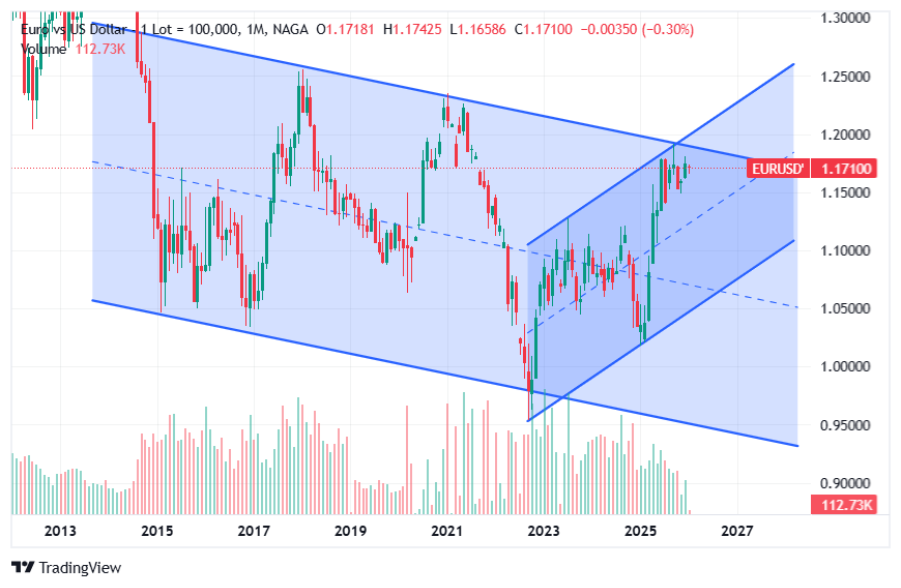
In the past, the pair was in a prolonged downtrend, bottoming near parity before beginning a sustained recovery. The corrective structure transitioned into a consolidation phase throughout much of 2023 and early 2024, where the pair oscillated sideways around the moving averages. This phase was marked by repeated rejections at resistance zones but also consistent support around the 1.05–1.07 region, building a broader base before the breakout that followed.
Past performance is not a reliable indicator of future results. All historical data, including but not limited to returns, volatility, and other performance metrics, should not be construed as a guarantee of future performance.
The recent price action has been bullish, with EURUSD surging above the 2023 and 2024 resistance zone and reaching highs near 1.19.
Indicators suggest that momentum remains favorable for the bulls. The RSI at 63 points toward bullish bias but not yet overbought, leaving room for further upside. The stochastic oscillator is hovering near the upper zone around 70–80, reflecting strong buying pressure but showing potential for near-term pauses. Moving averages are now aligned bullishly, with price trading comfortably above the 50-, 100-, and 200-week MAs. The 1.15 zone serves as firm support, while resistance levels to monitor lie at 1.1870 and the psychological 1.20 barrier.
The main scenario favors a continuation of the bullish trend, with price likely to attempt a break of the 1.1870–1.20 resistance cluster. A weekly close above 1.20 could trigger further upside momentum, opening the path toward the most bullish EurUsd price predictions from big banks, which point to 1.25 as a 2026 price target. As long as EURUSD remains above 1.15, the structure supports sustained bullish momentum with higher lows reinforcing the trend.
An alternative scenario would involve a rejection from the 1.1870–1.20 zone, leading to a corrective pullback. In that case, the first support lies at 1.1685, followed by a deeper test of 1.15. A break back below 1.15 would weaken the bullish structure and potentially return the pair to consolidation between 1.12–1.15.
Visit NAGA Academy to learn more
How do analysts see the market moving in the coming months and years? Below, we review projections: U.S. record highs, Fed-cut hopes, tech leadership, geopolitical risks.
Euro to Dollar Price Predictions 2026
Here we look at Euro to Dollar (EUR/USD) forecast for 2026, including comments from highly rated FX strategists.
Euro To Dollar Forecast End-2026: 1.25 at BNP Paribas
Contrary to traditional views, BNP Paribas suggests that the euro could appreciate to 1.25 by the end of 2026 maintaining a fundamentally bearish dollar stance. It points out that the US runs a persistent current account deficit while also running a substantial and growing international investment position deficit.
It also considers that the currency is still overvalued by over 20% and that there is a growing case for global investors to diversify asset holdings away from the US, which could lead to sustained dollar selling. BNP also considers that there will be a significant negative impact on the economy from tariffs, with slower underlying growth.
Bearish Euro to Dollar price prediction 2026 from JP Morgan
J.P. Morgan forecast the Eur/Usd to trade around 1.20 during the year, citing that aggressive Fed rate cuts will erode real USD yields while tariff policies under President Trump will add volatility. However, eurozone inflation control supports ECB patience.
Bullish Euro to Dollar price prediction 2026 from Goldman Sachs
Goldman Sachs targets 1.25 by year-end 2026, betting on a structural USD reversal as global capital reallocates to higher European yields and growth differentials narrow, though French fiscal risks pose near-term hurdles.
Bullish Euro to Dollar Price Prediction 2026 from Scotiabank
Scotiabank analysts suggest that while the euro's rally may face challenges above the 1.20 level, bullish trends could support further gains towards 1.22 during 2026. The main reason is the gradual appreciation of the euro as US-eurozone rate differentials narrow and global risk sentiment remains broadly constructive. At the same time, they note that the path is unlikely to be linear: periods of risk aversion or renewed US–EU trade tensions could temporarily support the US dollar and cap EURUSD rallies.
Bullish Euro to Dollar price prediction from UBS
UBS has revised its forecasts, now expecting the EUR/USD to advance toward 1.20, down from 1.23 a few months ago. This projection considers the political uncertainty in France. The bank sees scope for appreciation as U.S. data weakens post-shutdown and the ECB nears the end of its easing cycle, improving the rate backdrop for the single currency.
Neutral Euro to Dollar Forecast 2025 from Wells Fargo
Analysts at Wells Fargo project that the EUR/USD exchange rate will remain around 1.18 in Q1 2026 and 1.19 in Q2 2026, before easing back to 1.18 in Q3 and 1.17 again by Q4 2026. This profile implies a mid-year peak followed by a mild dollar rebound as the Fed ends its easing cycle and US yields stabilise.
Bullish Euro to Dollar Forecast 2026 from ING
ING estimates EURUSD “fair value” rising from the 1.15 area toward 1.20 and explicitly forecasts the pair at 1.21 by Q4 2026 and around 1.22 on a 12-month horizon beyond that. This is a clearly bullish scenario for the euro but assumes no major political shocks in the eurozone or the US.
Bullish Euro to Dollar Forecast from Deutche Bank
The German bank forecast EURUSD at 1.25 by end-2026, anchored by a rebound in global growth, a large German infrastructure program, and a potential improvement in geopolitical conditions. A recovery in Asian currencies—particularly the yen and yuan—is a key assumption behind their expectation of broad-based dollar softness.
Bearish EurUsd rate forecast from Morgan Stanley
Morgan Stanley forecasts the Eur/Usd pair to close 2025 at 1.16 after an early peak near 1.23. Their bearish Eur/Usd outlook is based on the US economic stabilization mid-year reins in dollar downside, tempered by ECB easing if inflation undershoots.
Bullish Euro to Dollar outlook from MUFG
MUFG calls for 1.24 with a 5% decline in the US Dollar Index (DXY), as markets price in additional Fed cuts beyond consensus and G10 yield convergence accelerates, strengthening the euro across the board.
Bank/Firm 2026 Year-End Target Key Drivers Goldman Sachs 1.25 Structural USD decline, capital flows to Europe J.P. Morgan 1.20 Fed easing, tariff uncertainty Morgan Stanley 1.16 Early gains fade on US stabilization UBS 1.20 ECB pause, US data weakness Deutsche Bank 1.25 German stimulus, Asia recovery MUFG 1.24 5% DXY drop, Fed cuts beyond priced Table with Euro to US Dollar (Eur/Usd) Forecast and Price Predictions
EurUsd price predictions based on AI
Here are the أبريل 2026 EURUSD price predictions from the most popular AI-based sources.
Wallet Investor
According to Wallet Investor's AI-driven analysis, the EUR/USD rate is expected to trade upwards during the first half of 2026, and close June at 1,1850. As of January 2026, Wallet Investor forecasts the EUR/USD pair to range approximately between 1.17 and 1.19 in 2026.
Longforecast.com
According to Long Forecast, the EUR/USD exchange rate is projected to experience steady growth throughout 2026. The forecast anticipates the EUR/USD rate to reach as high as 1.28 by December 2026, with strong growth throughout the second half of the year.
Stockinvest.us
The overall sentiment from Stockinvest.us suggests a positive EurUsd forecast for 2026. According to their analysis, the EUR/USD pair is showing buy signals from both short and long-term moving averages, suggesting a bullish forecast. Resistance levels are expected around 1.1800, while on a fall, the currency pair may find support from the long-term average at approximately 1.1700.
*It is worth keeping in mind that both analysts and online forecasting sites can and do get their predictions wrong. The EurUsd price predictions based on AI are generated using algorithmic and AI-based models that rely on historical data and assumptions. Keep in mind that past performance and forecasts are not reliable indicators of future returns.
When considering EurUsd forecasts and price predictions for 2026 and beyond, it’s important to keep in mind that high market volatility and the macroeconomic environment make it difficult to produce accurate long-term EurUsd analyses and estimates. As such, analysts and forecasters can get their EurUsd forecast wrong.
It is essential to do your research and always remember your decision to trade depends on your attitude to risk, your expertise in the market, the spread of your investment portfolio, and how comfortable you feel about losing money. You should never invest money that you cannot afford to lose.
What Drives the Euro / US Dollar Currency Pair
The EUR/USD trend depends on what stage of the cycle the global economy is at. During a recession, the demand for safe-haven assets, including the US dollar, increases. As a result, the Eurodollar often goes down. In recent years, monetary policy divergence, interest rate differentials, and geopolitical factors have also played an outsized role.
During a recovery from a recession, investors are not that focused on preserving money. Retail investors search for ways to multiply the deposit. At this stage, the fundamentals driving the EUR/USD currency pair are the GDP growth rates and, even more, the monetary policy of central banks and the expected path of interest rates. In 2024–2025, the ECB began cutting rates ahead of the Fed, reducing the euro’s yield appeal and pressuring the currency.
A strong economy means a strong currency. The rapid rebound of GDP after the recession is a reason to buy securities of the country. In particular, the belief that the US economy would avoid a hard landing in 2024–2025 and maintain a growth and yield advantage over the Eurozone accompanied a strong S&P 500 performance into 2025. As a result, alongside capital flows and wider yield spreads, the US dollar was supported.
The GDP rate is a reliable indicator but, unfortunately, lagging. The GDP report is published a month or month and a half after the end of the quarter. Therefore, it is very difficult to determine whose economy is growing faster at a particular time, which doesn’t provide a clear picture of the current economic situation to investors. That is why forex traders have to monitor some leading macroeconomic indicators, such as the US and Eurozone PMIs, inflation, and labor market data.
The more the economy heats up, the more likely the central bank to raise the interest rates. However, by 2025 most major central banks had already ended quantitative easing and shifted to managing the timing and pace of rate cuts. As a result, the assets denominated in the local currency grow more attractively when relative yields rise. That is why the US dollar was firm into early 2025, while growing expectations of Fed cuts later in the year have limited further gains.
To understand the Fed’s intentions, one should track such indicators as inflation and unemployment rate. When these indicators move toward the thresholds set by the Fed, the central bank starts easing policy. In this case, the greenback may lose in value, especially if the ECB eases more slowly; conversely, if US yields remain higher, the dollar tends to stay strong.
Speeches of central bank representatives are important in forecasting the EUR/USD exchange rate. The officials’ comments give a clue on how the central banks’ policies could change, and investors could develop trading strategies based on this. Forward guidance on the rate path, balance-sheet plans, and risk assessments remains a key driver of the pair.
EUR/USD Trading Tips
- A necessary condition to look for buy opportunities in the long term is the sync trends in the global economy. If the US GDP features robust growth, but China and the euro area face problems, look for sell opportunities. However, in 2025 this signal is not sufficient on its own, so also weigh Federal Reserve and ECB policy guidance, inflation dynamics, and risk sentiment when judging EUR/USD direction.
- Monitor the global financial markets. If the S&P 500 and oil are rallying up simultaneously, it is not a standalone reason to buy the Euro versus US Dollar, as these correlations have been variable in recent years. If the stock index is growing and the oil is falling in value, or both financial assets are depreciating, do not treat this as a mechanical cue to sell the EURUSD. Instead, focus on interest-rate differentials, central bank communications, and high-impact macro releases to define the bias.
- Study the history of the financial asset’s quotes. An example that took place in the past may emerge in the future as a potential EUR/USD price movement, but validate such setups with backtesting and statistical checks before relying on them in live trading.
- Use technical indicators in trading the EUR/USD to determine the current market state and key support/resistance levels. If the Moving averages often cross the EURUSD chart, the market is trading flat. If the price chart is above the EMA, the trend is bullish; if the price is below the indicator, the underlying trend is bearish and many traders now add RSI or MACD and use multi‑timeframe confirmation to reduce false signals.
- Use Japanese chart patterns and western chart patterns like head and shoulders, double top and bottom, or triangles to identify entry and exit points. Confirm the pattern with momentum, volume, or clear price‑action triggers to improve reliability.
- Do not try to use all popular trading strategies; you’d better find the one that suits you best. Whether discretionary or algorithmic, keep risk management tight and stay alert to policy headlines and geopolitical developments that can move EUR/USD quickly.
- Always observe the rules of your online trading system.
EUR/USD price history
In the beginning, the EUR/USD currency pair was trading below parity. However, while the euro stayed above $1,00 for two decades after 2002, it briefly fell back below parity in 2022. The euro-dollar all-time low is about 0.8230 (October 2000); the record high is close to 1.604 (July 2008).
In 2020, the global economy faced a recession, which lasted for only two months. Because of the panic in financial markets, the demand for the Greenback sharply increased. As a result, the EURUSD dropped to a level of 1.064, the lowest since April 2017.
Central banks launched colossal monetary incentives of trillions of dollars to support their economies. The Fed acted very extreme and had cut their rate down from 1.75% to near 0.00% and started the Quantitative Easing at a monthly pace of $120 billion. The Federal Reserve balance sheet was growing rapidly, approaching $9 trillion, and the US dollar weakened against a basket of major currencies later in 2020. In particular, the euro ultimately advanced and reached $1.2340 in January 2021.
In late 2020, the euro was expected to rise further. Many banks suggested the EURUSD should have exceeded 1.2500 in 2021. Some aggressive bulls expected the euro to trade around $1.300. In the end, things turned out differently. Extended lockdowns in the EU, due to rising infections had caused a double recession, the euro lost sharp momentum again towards 1.1705.
Eventually, as infections on a global scale turned less severe also the economy was able to rise again. Governments had turned their focus away from the Covid- 19 pandemic. Furthermore, the EURUSD buyers were again encouraged to invest in the Euro as economic data had started to improve. Fed’s unwillingness to recognize a surge in US inflation also helped the common currency back then. The pair moved towards the 1.2260 level in late May. Bulls again were aiming at 1.2500, but the FOMC June projection broke the uptrend again. The Fed started talking about a potential rate hike in 2022, which encouraged investors to buy the US dollar and set the stage for an aggressive tightening cycle.
After falling from 1.2275 at the start of 2021, EUR/USD started 2022 at 1.1375. The price rose to a high of 1.1495 in early February before steadily dropping to a low of 1.0380 on May 13 – a level last seen in January 2017. By July–October 2022 the pair broke parity for the first time in two decades, sliding to around 0.95–0.96 amid Europe’s energy shock, the war in Ukraine, and rapid Fed hikes. In 2023 and 2024, EURUSD fluctuated mostly between 1.05 and 1.12 as policy and growth differentials ebbed and flowed. In 2025, the pair has traded in a broader 1.03–1.18 range and, as of August 19, 2025, is hovering near 1.17.
The pair briefly breached parity on 13 July, as markets reacted to US inflation figures. That was followed by an immediate rebound that sent EUR/USD back above 1.0100.
As of 15 July 2022, the pair has fallen over 12% year-to-date to trade around the 1.0000 level.
EUR/USD began 2022 at $1.1375, down from $1.2275 at the beginning of 2021. Early in February, the price of the pair reached a high of $1.1495 before progressively declining to a low of $1.0380 on May 13 - a level last reached in January 2017.
The pair fell below $0.99 on September 5 for the first time in 20 years as a result of Russia shutting down its main gas pipeline to the EU, severely jeopardizing the euro zone's economic prospects.
Midway through December, the EUR/USD traded back up to around the $1.06 level due to a weaker dollar and declining US Treasury yields. The ECB increased interest rates by 50 basis points (bps) as anticipated on December 15, reiterating that more hikes will follow, and outlining plans for quantitative tightening. However, the pair benefited from a general decline in the value of the US dollar as inflationary pressures in the country continued to subside.
The euro-to-dollar exchange rate started in 2023 at $1.0703 and increased during the month of January, topping $1.08 for a brief while. During the year, the pair traded sideways, with the trading range 1.05-1.10 violated only once in July, toward 1.1280, for a short period of time.
The recent trading range which traders had expected in 2023 and 2024 did come to an end in 2025. After such a small range the market did break out of such a trend, with EUR/USD pushing to about $1.1666 by mid-July. Since a vacuum had built up, a sudden breakout was on the cards; by August 19, 2025, the pair was trading around $1.168-$1.171, leaving the euro over 13% higher on the year.
Final words
It’s important to remember that any long-term forecasts, even the EUR/USD forecast, or any other currency pair, are too unreliable to believe in. As of January 2026, EUR/USD is near 1.17, and many analyses see consolidation around 1.20 this year; still, too many factors may affect the rate of the currency pair, and it’s best to be up to date with what’s happening in the global arena in order to make realistic and reliable predictions.
If you do decide that trading this currency pair is something for you, and you believe in the future of the Euro vs. US Dollar pair, first, you need to decide on a suitable trading strategy for you and work it out first on a demo account, and then on a real account.
You can start in minutes by opening a trading account with NAGA.com! We provide a user-friendly trading app with an outlook for novices as well as experienced traders and investors.
Read also our daily and weekly updates on other markets:
- Gold analysis and price forecast 2026
- Oil analysis and price forecast 2026
- Dow Jones analysis and forecasts 2026
- Nasdaq-100 forecast and price predictions 2026
- Silver forecast and price predictions 2026
- Natural Gas forecast and price predictions 2026
- Turkish Lira forecast and price predictions 2026
- British Pound forecast and price predictions 2026
- USD to INR forecast 2025, 2027, 2030
- AED to INR forecast 2026, 2026, 2030
- SAR to INR forecast 2026, 2027, 2030
- IBEX 35 forecast and price predictions 2026
Sources:
- http://www.forecasts.org/euro.htm
- https://think.ing.com/articles/federal-reserve-preview-fed-to-hold-the-line-but-cuts-are-coming
- https://www.commerzbank.de/group/research/forecasts
- https://www.federalreserve.gov/releases/h15
- https://www.imf.org/en/Publications/WEO
- https://www.jpmorgan.com/insights/global-research/economy/eurozone-outlook
- https://www.wellsfargo.com/cib/insights/economics/international-outlook